
China has become one of the world’s most important manufacturing bases for press brakes, offering everything from economical torsion-bar machines to multi-axis electro-hydraulic CNC press brakes, all-electric systems, tandem machines, robotic bending cells and automatic panel benders.
However, a large number of available brands does not automatically make purchasing easier.
Two machines described as “135-ton, 3,200 mm, 6+1-axis CNC press brakes” may differ substantially in frame design, working length, stroke, daylight, throat depth, cylinder synchronization, crowning, backgauge structure, controller functions, tooling, safety system, documentation and after-sales support.
The same problem applies when comparing manufacturers.
A company may operate its own factory, while another may use a separate manufacturing, export or sales entity. Some suppliers publish detailed specifications and service information, while others rely heavily on broad claims such as “high precision,” “European technology,” “global service” or “top manufacturer.”
For this reason, buyers should not begin by asking:
Which Chinese press brake manufacturer is the best?
A more useful question is:
Which manufacturer has a documented product structure, engineering capability and service model that best matches my parts, production requirements, destination market and acceptable level of purchasing risk?
This guide reviews ten representative press brake manufacturers in China using a common research structure. It is designed to help buyers create a technically comparable shortlist rather than present an official ranking.
This buyer’s guide is published by Nanjing ZYCO CNC Machinery Co., Ltd., one of the manufacturers included in the article.
The companies are not ranked from best to worst, and inclusion does not mean that an independent organization has officially identified them as the top ten press brake manufacturers in China.
Every manufacturer is reviewed using the same structure:
Most information about private manufacturers comes from their official websites and product documentation. Figures concerning factory size, employee count, annual production, export countries, accuracy, energy savings or service coverage should therefore be understood as manufacturer disclosures unless an independent source is specifically cited.
Buyers should independently verify all technical, legal, commercial and compliance information before placing an order.
No.
There is no single internationally recognized authority that publishes a definitive, audited ranking of the top 10 press brake manufacturers in China.
Different lists may use very different criteria:
A large diversified machine-tool group may have more corporate resources but may not focus primarily on press brakes. A smaller specialist may offer more flexible configurations or closer application support but have a more limited overseas service network.
The ten companies in this guide were selected because they represent different segments of the Chinese press brake market and have sufficient public information to support a structured buyer comparison.
They are listed alphabetically, not by performance:
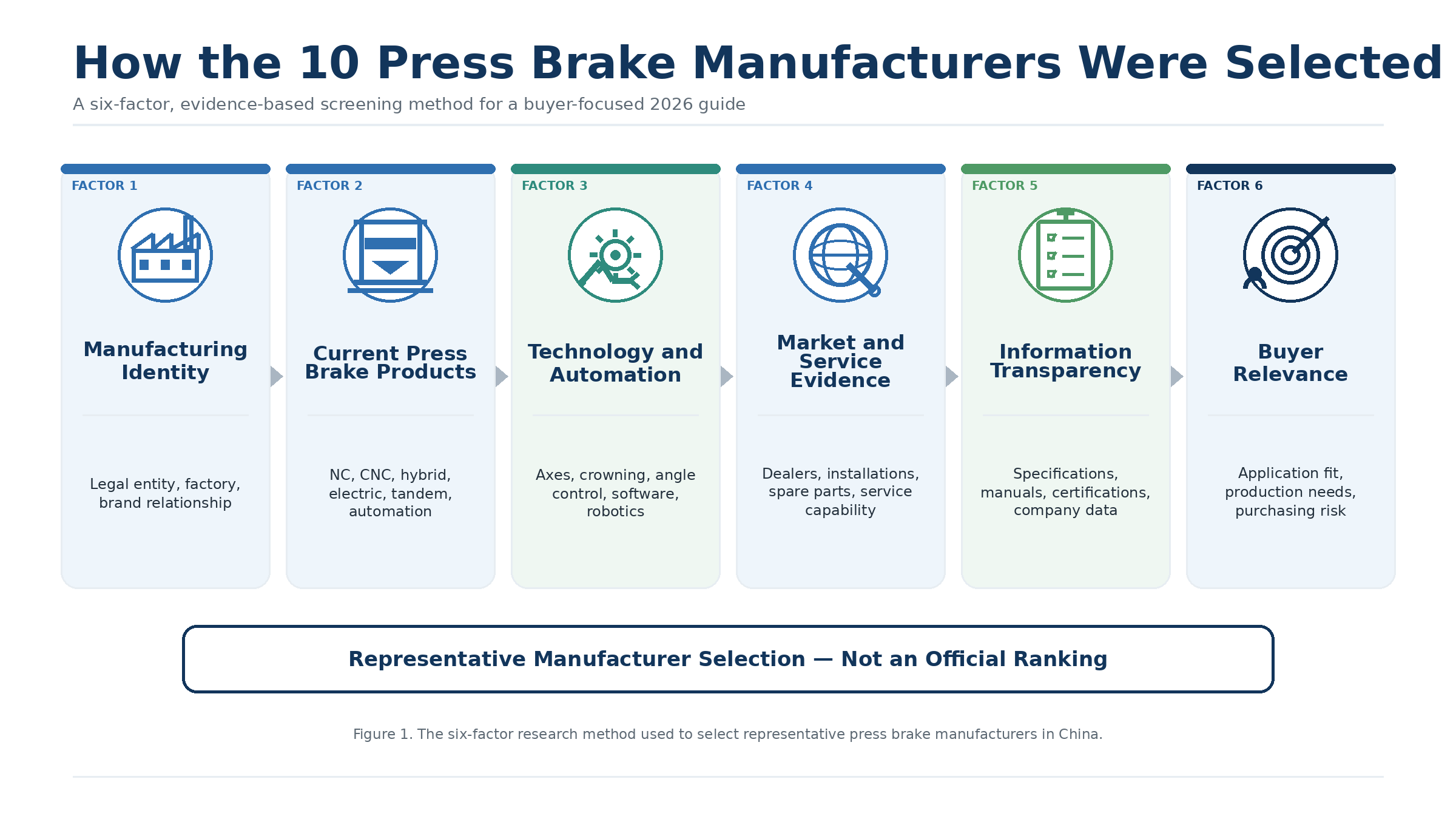
The first requirement was evidence that the company or associated legal entity is involved in manufacturing press brakes or metal-forming machinery in China.
This is important because the brand shown on a website may not always be the same entity that:
A buyer should be able to identify these relationships before payment.
Each selected company currently publishes information about press brakes as a meaningful part of its product portfolio.
The review considered whether the manufacturer documents one or more of the following:
A larger product range is not automatically evidence of better quality. It indicates the types of applications a supplier may be prepared to support.
Preference was given to manufacturers that provide useful information about machine architecture, such as:
Manufacturers were easier to assess when their official materials clearly showed:
Information transparency does not prove machine quality, but it reduces uncertainty during early supplier screening.
The research also considered whether the manufacturer showed recent activity in 2025 or 2026, including:
Recent activity helps confirm that the product line and contact channels remain active. It should not be treated as evidence of sales volume or market ranking.
The final selection was designed to represent several purchasing profiles:
The table below summarizes documented positioning, not machine quality or overall ranking.
|
Manufacturer |
Documented Press Brake Focus |
Automation Visibility |
Typical Buyer Profile |
Main Verification Priority |
|
ACCURL |
Hydraulic CNC, hybrid, all-electric, multi-axis and tandem systems |
High |
Buyers seeking advanced configurations and automation options |
Legal manufacturing entity, local service and test conditions |
|
ADH |
NC, electro-hydraulic CNC, electric, large and tandem machines |
High |
Growing fabricators, distributors and heavy-duty users |
Company-history wording, contract entity and service coverage |
|
DURMAPRESS |
Entry-level NC through multi-axis, electric, hybrid, tandem and robotic systems |
High |
Buyers comparing many configurations from one supplier |
Legal entity consistency, standard configuration and certification |
|
HARSLE |
Entry-level, multi-axis CNC, electric and tandem machines |
Medium |
Small and medium-sized international fabricators |
Legal entity, warranty scope and local-service evidence |
|
JFY |
Servo-hydraulic and direct-drive all-electric press brakes |
Medium |
Buyers valuing a structured international machine-tool ecosystem |
Dealer responsibility, software, tooling and service boundaries |
|
KRRASS |
NC, electro-hydraulic CNC, servo/hybrid and electric products |
Medium |
Cost-conscious buyers needing configurable CNC equipment |
Brand ownership, contracting entity and product-definition consistency |
|
SHENCHONG |
Hydraulic CNC, hybrid, tandem, robotic and panel bending |
High |
Custom automation and long-part bending projects |
System integration, FAT responsibility and local support |
|
YANGLI |
CNC bending within a broad metal-forming group portfolio |
Medium |
Industrial groups buying multiple forming technologies |
Current export configurations and responsible legal entity |
|
YAWEI |
High-end CNC, hybrid, all-electric, heavy-duty and panel bending |
High |
Larger factories and automation-oriented manufacturers |
Standard versus optional functions and local support |
|
ZYCO |
Configurable NC/CNC, electro-hydraulic, electric and panel bending products |
Medium |
Small and growing international sheet metal manufacturers |
Exact axis configuration, installation model and compliance documents |
The table should be used to decide which companies deserve a detailed RFQ. It should not replace machine-specific technical evaluation.
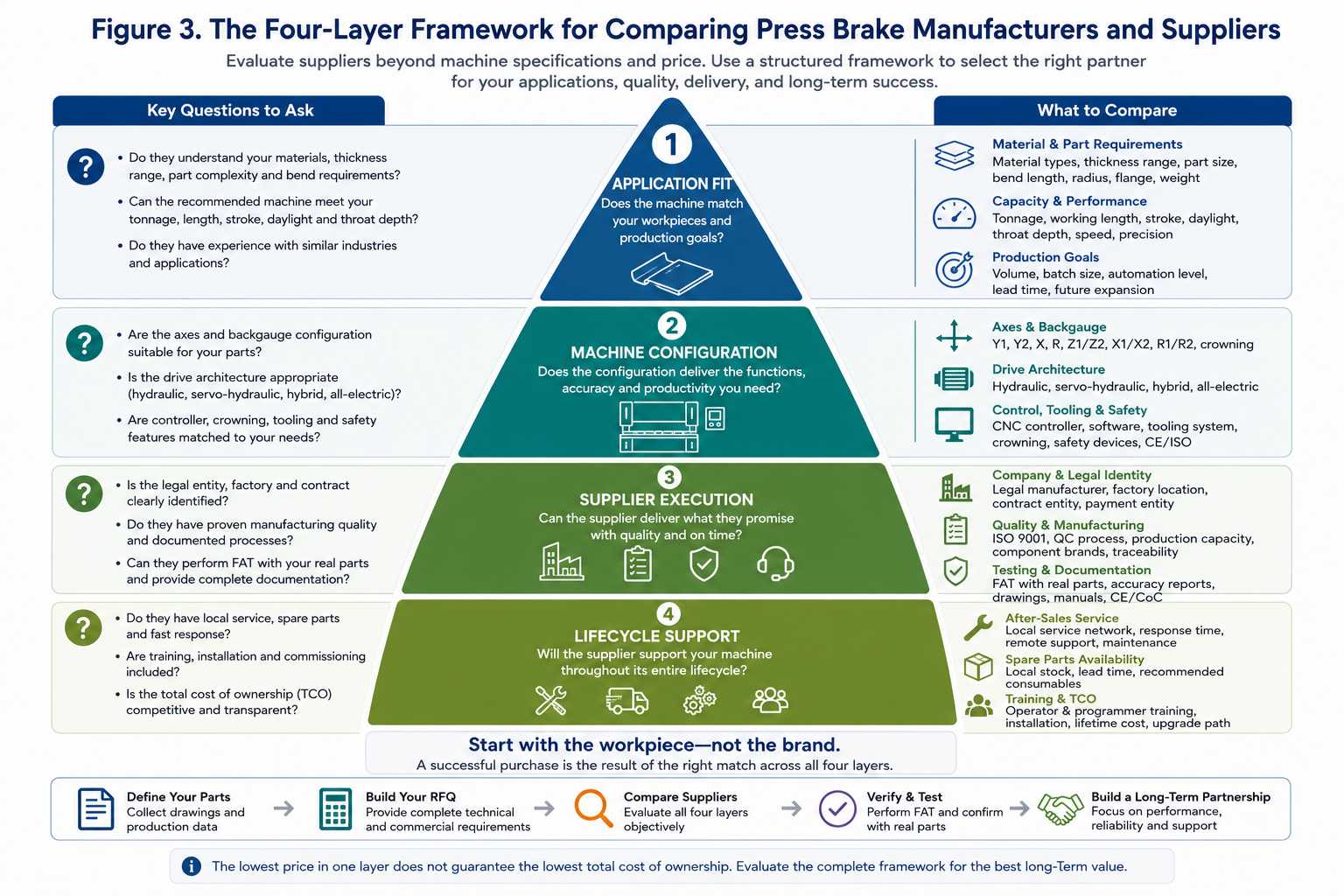
The correct press brake should be selected from the buyer’s actual parts.
Before contacting any press brake suppliers in China, prepare a representative workpiece package containing:
The most demanding part is not always the thickest part.
A long thin panel may require more working length and crowning control. A short thick part may create a high concentrated load. A deep box may require greater daylight, stroke, throat depth or special tooling. A narrow flange may require a smaller V opening and therefore higher tonnage.
A supplier that asks only for “maximum thickness and maximum length” does not yet have enough information to recommend a complete machine.
Nominal press brake tonnage must be evaluated together with:
A machine labelled 160 tons does not necessarily allow 160 tons to be applied over every short section of the bed.
Buyers should request:
1. the tonnage calculation for representative parts;
2. the proposed V-die opening;
3. the required force per metre;
4. the punch and die load ratings;
5. the allowable concentrated load;
6. the allowable off-centre load;
7. and the manufacturer’s recommended safety margin.
Do not solve a tooling or bend-method problem simply by purchasing a much larger press brake. Excessive machine capacity may increase cost, footprint and energy use without solving small-flange, interference or tooling limitations.
The actual bend line is the length of the part that is bent in one stroke.
Machine working length is the usable length of the table and ram.
The selected working length must also consider:
A buyer should not automatically choose a 4,000 mm press brake because the largest sheet is 4,000 mm long. The actual bend direction and bend-line length may be much shorter—or the part geometry may require more space than the bend line alone suggests.
Tonnage and length are only the beginning.
Stroke affects the machine’s ability to:
Daylight is the maximum opening between the ram and table under the manufacturer’s stated reference condition.
When comparing daylight, confirm whether the value includes:
Throat depth affects the distance a sheet or formed part can extend behind the bending line without contacting the side frame.
A machine can have adequate tonnage and working length but still be unsuitable because the finished part cannot be inserted or removed.
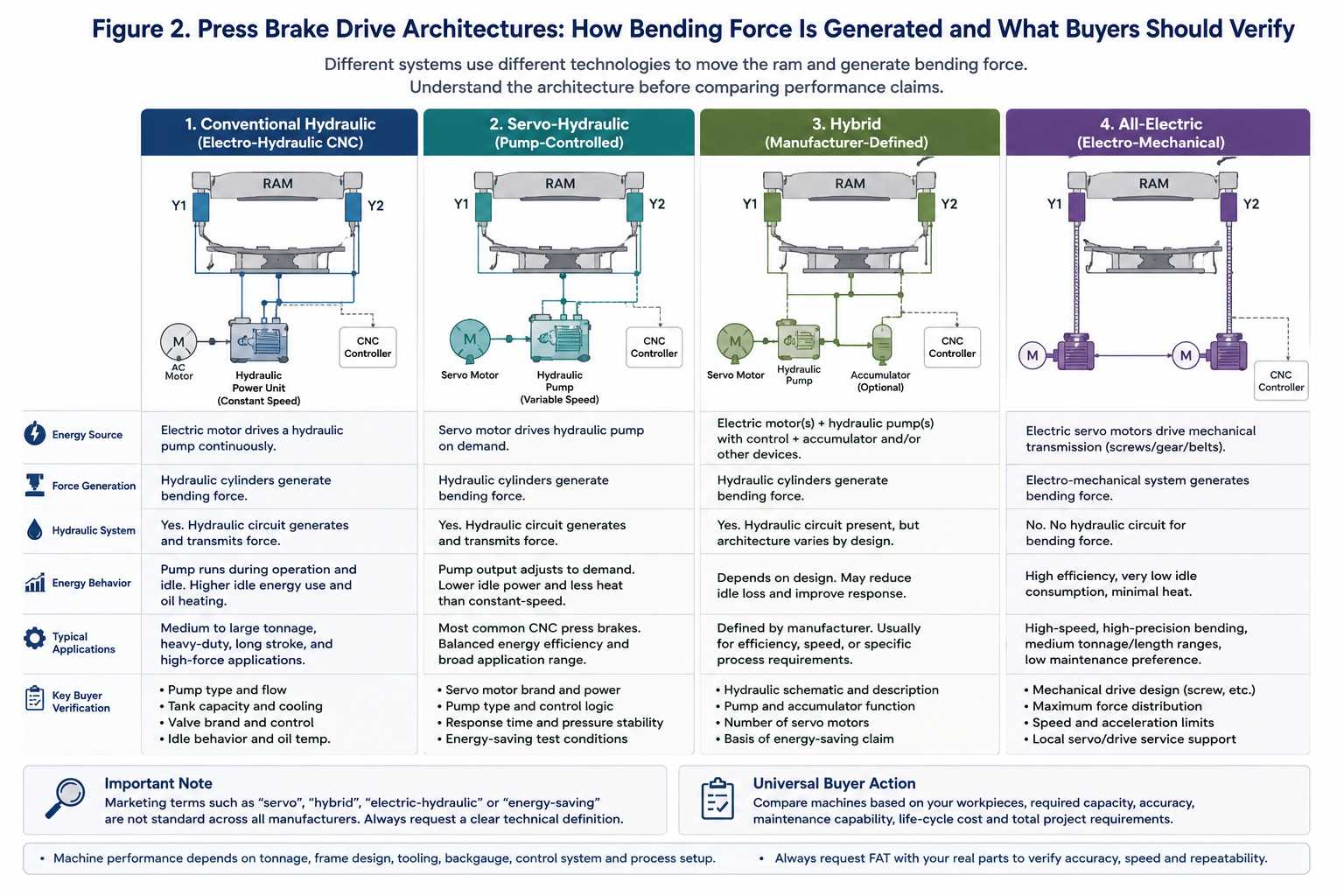
Marketing terminology is inconsistent across the industry.
A supplier may use “servo,” “hybrid,” “electric-hydraulic” or “energy-saving” without clearly explaining how bending force is generated.
Ask the supplier to classify the machine mechanically.
Hydraulic cylinders generate the bending force. On modern synchronized machines, Y1 and Y2 are controlled through a closed-loop electro-hydraulic system.
Servo motors drive hydraulic pumps more responsively than a continuously operating conventional hydraulic power unit.
This can reduce idle energy use and oil heating, but it remains a hydraulic press brake.
“Hybrid” may describe several different arrangements. Buyers must request:
An all-electric press brake generates ram movement and bending force through an electromechanical drive rather than a conventional hydraulic bending circuit.
All-electric machines can be attractive for speed, lower hydraulic maintenance and reduced standby consumption, but buyers must still evaluate:
“All-electric” is not automatically better for every application.
Axis-count marketing can be misleading.
A quotation should not merely state:
6-axis CNC press brake
It should identify each controlled axis.
Common axes include:
Crowning should be identified separately because some suppliers count it as “+1,” while others include it within a broader axis total.
The correct axis configuration depends on the parts.
A simple workshop producing straight brackets may need only Y1, Y2 and X. A high-mix factory producing asymmetrical enclosures may benefit from R, Z1/Z2 or independently controlled X and R axes.
More axes add capability, but they also add cost, programming complexity, maintenance requirements and collision risk.
Long parts can show different angles at the left, centre and right because the ram and table deflect under load.
Possible compensation methods include:
Ask each manufacturer:
Angle-measurement systems can reduce dependence on trial bending, but they do not eliminate the effects of inconsistent material thickness, tensile strength, grain direction, tooling wear or poor process setup.
Any accuracy claim should include test conditions.
The controller logo alone does not define the capability of the complete machine.
A supplier may install an advanced controller on a mechanically simple backgauge. The controller cannot create movement axes that the machine does not physically have.
The quotation should therefore show:
Controller model + physical axis configuration + standard software + optional software.
Press brake tooling determines whether the planned parts can actually be produced.
The RFQ should specify:
Buyers should also request a tooling layout for representative parts.
A press brake with sufficient tonnage may still fail the application because:
In May 2026, ISO published ISO 6909:2026, Machine tools — Safety — Press brakes. The standard covers hydraulic, hydraulic servo-drive, screw servo-drive and belt-spring servo-drive press brakes and addresses significant hazards across the machine lifecycle.
Other relevant standards may include:
The applicable legal and standards framework depends on the destination market and actual market-placement date.
For machinery placed on the EU market, Machinery Directive 2006/42/EC remains applicable until January 19, 2027. Regulation (EU) 2023/1230 applies from January 20, 2027. Buyers ordering in 2026 for delivery or market placement in 2027 should confirm which framework will apply to the project.
CE marking is a manufacturer’s declaration that the product meets applicable EU legal requirements. It is not a machine-quality award and does not prove bending accuracy, service quality or long-term reliability. The manufacturer must complete the appropriate conformity assessment, technical documentation and Declaration of Conformity before applying the mark.
Buyers should request:
Compliance with an ISO standard does not automatically create EU presumption of conformity. For that legal effect, the relevant harmonized standard reference must be published in the Official Journal of the European Union.
ISO 9001 certification can support confidence in a manufacturer’s quality-management system, but it does not certify the performance or safety of a specific press brake.
ACCURL describes itself as a Chinese manufacturer of sheet metal machinery covering CNC press brakes, fiber laser cutting machines, punching and forming technology, automation and programming systems. Its current company profile states that the ACCURL brand was founded in 2014. The manufacturer also reported opening a new smart factory in November 2025. These dates should be treated carefully because some older ACCURL pages contain different historical wording; buyers should rely on the current contracting and manufacturing entity rather than combining every historical claim.
ACCURL’s current press brake portfolio includes hydraulic CNC, hybrid, all-electric, multi-axis, robotic and tandem configurations. Its official press brake page states that available machines range from small systems to tandem installations and can be configured with multiple controlled axes. ACCURL also promotes laser-assisted angle-measurement and robotic bending options.
ACCURL is positioned toward buyers looking for a broad choice of drive systems, multi-axis backgauges, automated angle correction and customized bending cells.
The company’s online presentation emphasizes higher-level CNC configurations rather than only economical torsion-bar machines. This makes ACCURL relevant to buyers comparing hybrid, all-electric and automation-ready architectures.
However, published claims concerning precision, energy savings, production capacity or service coverage should be verified under defined test and contractual conditions.
ACCURL may be considered by:
Buyers should confirm:
ADH’s official timeline distinguishes between the founder’s industry background beginning in 1982 and the establishment of the manufacturing business in 2001. This distinction is important: describing ADH simply as “founded in 1982” would combine the founder’s earlier work history with the company’s stated establishment date.
ADH presents itself as a manufacturer of press brakes, panel benders, laser-cutting machines and shearing equipment.
ADH publishes products across economical NC, electro-hydraulic CNC, electric, tandem, large-format and automated bending categories. It also lists panel bending as a separate machine category and promotes several CNC controller choices.
This broad range allows buyers to compare a basic workshop machine with larger or more automated equipment under one supplier brand.
ADH is positioned as a broad-range, export-oriented supplier serving both general sheet metal fabrication and heavier custom applications.
Its portfolio is relevant to buyers moving from torsion-bar equipment toward electro-hydraulic synchronization, all-electric bending, large machines or automated cells.
Because the company publishes ambitious statements regarding manufacturing history, warranties and international activity, buyers should separate:
ADH may be suitable for:
Confirm:
For automated cells, request a clear division of warranty between the press brake, robot, gripper, safety equipment and software.
DURMAPRESS’s current company profile identifies Anhui Durmapress CNC Machine Tool Manufacturing Co., Ltd. in Maanshan, Anhui, and states that the business was founded in 2014. Other pages on the same website contain earlier historical references, including factory activity from 2000 or marketing statements such as “since 2005.” The safest buyer approach is therefore to confirm which history relates to the current brand, factory and legal contracting entity.
DURMAPRESS publishes one of the broadest product structures in this group. Its current press brake range includes:
The brand also lists panel benders and other sheet metal machinery.
DURMAPRESS is positioned for buyers who want to compare several machine architectures within one supplier.
This can simplify initial sourcing, particularly for distributors or factories evaluating:
The wide portfolio also increases the importance of verifying which products are standardized, which are customized and which have a sufficiently documented installation history.
DURMAPRESS may be considered for:
Buyers should request written clarification of:
Also verify:
HARSLE presents itself as an international-facing manufacturer of press brakes and other sheet metal equipment. Its company page publishes customer, production, export and company-age figures, but these remain manufacturer disclosures and should not be treated as independently audited statistics. A HARSLE tooling-division page identifies the legal company name as Nanjing HARSLE Machine Tool Co., Ltd.
HARSLE’s current range includes NC and CNC hydraulic machines, multi-axis models, servo-electric products and synchronized tandem systems. Its website organizes products into several families, including E-Bend electric machines and tandem solutions for long workpieces.
HARSLE also operates a tooling-focused product division, which may be useful for buyers wishing to source punches, dies and clamping together with the machine.
HARSLE is positioned toward small and medium-sized international fabricators that prefer clearly segmented product levels and online access to machine and tooling information.
Its portfolio covers first CNC-machine purchases as well as electric and long-part applications.
The main due-diligence issue is not the visibility of its products, but verifying the legal, certification, warranty and overseas-service details behind broad marketing claims.
HARSLE may be shortlisted by:
Request:
Do not assume that a certification logo on a website applies to every model.
JFY has one of the clearest ownership structures among the companies in this guide.
TRUMPF acquired a majority interest in Jiangsu Jinfangyuan CNC Machine Company Ltd. in 2013 and acquired the remaining shares in May 2019. TRUMPF’s 2024/25 annual report continues to identify JFY as its Chinese machine-tool brand within the Machine Tools division.
JFY’s current sales terms identify the operating company as Jiangsu Jinfangyuan CNC Machine Co., Ltd.
JFY’s current international bending range is focused on:
JFY publicly emphasizes a structured machine, software, tooling and dealer ecosystem rather than the largest possible number of machine categories.
JFY occupies a distinct position within the group.
It is a China-manufactured machine-tool brand operating inside the TRUMPF Group, with emphasis on standardized products, software integration, tooling packages and dealer-supported international sales.
Buyers should not assume that every JFY machine has the same functions, specifications or service package as a TRUMPF-branded press brake. The exact relationship must be clarified for each quotation.
JFY may be suitable for:
Confirm:
Manufacturer-published energy or productivity improvements for the TPE8 should be evaluated against a stated reference machine, part and duty cycle.
KRRASS presents itself as a Chinese sheet metal machinery brand offering press brakes, laser-cutting machines, shears, rolling machines, panel benders and related services.
Its website associates the brand with Klaus/Kelaosi companies in Jiangsu. Independent government records confirm that Jiangsu Klaus Machine Tool Co., Ltd. has a 5G intelligent CNC machine-tool research and production project in Nanjing. The environmental filing describes a metal-forming machine-tool manufacturing project with installed production equipment. Government records also list a proposed high-precision CNC press brake engineering technology research centre under the same company.
These records confirm manufacturing investment by the named Chinese entity, but they do not independently prove every historical or global-network statement on the KRRASS website.
KRRASS publishes:
KRRASS is positioned toward buyers balancing machine cost with configurable controllers, backgauges and energy-conscious drive options.
It is relevant to workshops upgrading from simple torsion-bar machines and buyers comparing conventional electro-hydraulic, pump-controlled and electric structures.
The main research challenge is the relationship between the KRRASS brand and its various Chinese legal entities.
KRRASS may be considered for:
Before ordering, verify:
Also request a mechanical definition of “hybrid,” including hydraulic and servo schematics.
Any percentage-based energy-saving claim should state:
SHENCHONG’s official website identifies the company as Wuxi Shenchong Forging Machine Co., Ltd. and publishes press brakes, panel benders, shearing machines, rolling machines, laser equipment and automation products. Its company timeline states that it manufactured a robotic press brake in 2015.
SHENCHONG documents:
Its robotic pages show integration with industrial robots, dedicated grippers, positioning devices, guarding and material-handling equipment. A 2026 case describes installation and integration of an ABB robotic bending cell in Italy.
SHENCHONG is positioned toward customized automation, robotic bending and long-part applications rather than only standard standalone machines.
This makes it relevant when the buyer needs:
Automation capability must be verified through actual part testing rather than a general robot demonstration.
SHENCHONG may be suitable for:
The contract should clearly identify the party responsible for the complete cell.
Verify:
The FAT should use the buyer’s real parts and include:
YANGLI is a diversified Chinese metal-forming equipment group rather than a press-brake-only manufacturer.
Its official product structure includes mechanical presses, CNC sheet metal equipment, laser-cutting machines, general sheet metal machines and hydraulic presses. The group’s contact information separately identifies Jiangsu Yangli CNC Machine Tools Co., Ltd.
YANGLI publishes CNC and general bending-machine products including:
The HB product page describes servo-motor-driven hydraulic-pump architecture, electro-hydraulic cylinder synchronization and hydraulic crowning.
YANGLI is most relevant to larger industrial buyers that view bending as one part of a wider forming operation.
Its broader portfolio may be useful for projects involving:
Compared with some export-oriented specialist brands, portions of YANGLI’s English-language press brake information appear less recently presented. Buyers should therefore request the current export catalogue rather than rely only on older website controller and configuration details.
YANGLI may be considered by:
Confirm:
Jiangsu Yawei Machine Tool Co., Ltd. states that its history began in 1956 and that it became the first listed company in China’s metal-forming machine-tool industry when it listed under stock code 002559 in 2011. Its current company profile describes a broad focus on digital, flexible, automated and intelligent sheet metal processing.
YAWEI’s ownership and corporate information are more publicly visible than those of many private competitors, although performance and scale statements on its company page should still be understood within their stated source.
YAWEI publishes one of the most comprehensive documented bending portfolios in this group:
The PBE series is described as fully electric and oil-free. The PBM uses an oil-electric hybrid, pump-controlled synchronous architecture.
YAWEI is positioned toward higher-level CNC, electric, heavy-duty, panel-bending and automated production applications.
Its broad product range makes it relevant to factories comparing several bending technologies while also considering punching, laser cutting or intelligent-manufacturing systems.
The number of available functions means buyers must carefully distinguish standard equipment from optional packages.
YAWEI may be suitable for:
Confirm:
Nanjing ZYCO CNC Machinery Co., Ltd. states that it was established in 2013 and operates in automatic-control-system design, product development and machine-tool manufacturing. As the publisher of this article, ZYCO’s company statements must be treated using the same source limitations applied to other private manufacturers.
ZYCO’s current product range includes:
The company also publishes engineering content and selection guidance related to tonnage, V-die opening, bending methods, bend allowance, axes, controllers and press brake purchasing.
ZYCO is positioned toward small and growing international sheet metal manufacturers seeking configurable CNC controllers and practical machine-selection support.
Its public-facing differentiation is not an independently proven advantage in accuracy or reliability. It is the combination of:
This positioning can be useful to first-time buyers who need help connecting workpiece requirements with tonnage, working length, axes and tooling.
ZYCO may be considered for:
As with every supplier in this guide, buyers should confirm:
Regarding the quotation for the multi-axis CNC press brake, the contract should not state only “4+1,” “6+1” or “8+1.” It should list the included axes individually.
The following groups are starting points for RFQ creation, not performance rankings.
Buyers producing brackets, cabinets, frames and general fabricated components may initially compare:
These brands publish standard NC or CNC products aimed at broad fabrication requirements.
The final decision should depend on:
Manufacturers with publicly documented electric products include:
When comparing electric machines, examine:
Manufacturers with clearly visible robotic or automated bending content include:
Robotic bending should be selected from a part family, not from a general robot demonstration.
The buyer should evaluate:
Potential candidates include:
For long-part applications, buyers must verify:
Publicly visible panel-bending portfolios are available from:
Panel benders can be highly productive for suitable thin-sheet components, but they do not replace a press brake in every application.
Compare:
JFY, YANGLI and YAWEI may be particularly relevant when bending is one part of a broader machine-tool or automated-manufacturing project.
JFY operates within the TRUMPF Group, while YANGLI and YAWEI document broad portfolios extending beyond press brakes.
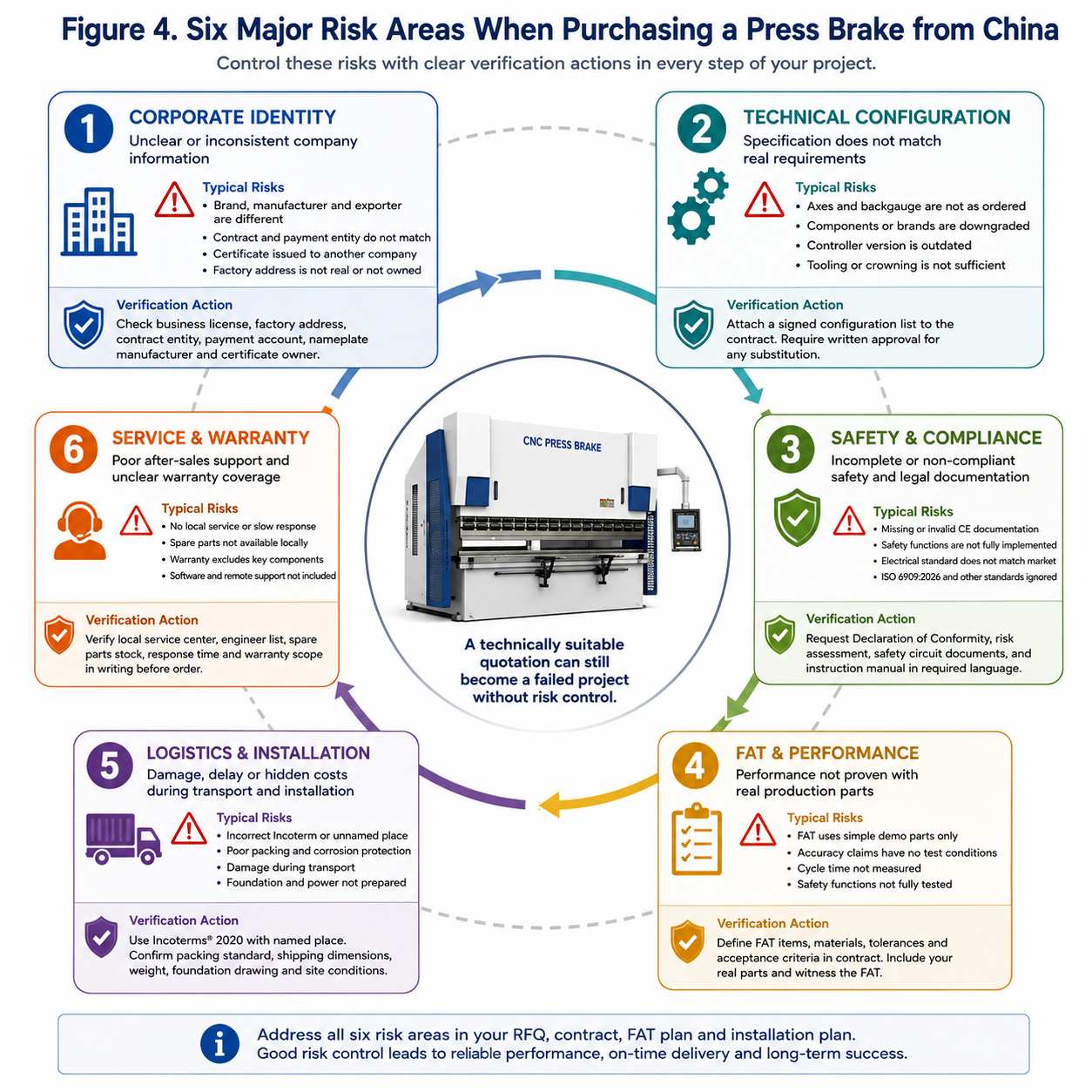
A brand may use different manufacturing, sales and export companies.
Before paying, compare:
Any mismatch should be explained in writing.
Common substitutions include:
Attach a signed configuration list to the contract. State that substitutions require written buyer approval.
This can lead to insufficient:
Use actual drawings.
Never accept “6-axis” without an axis list.
Specify every axis and clarify whether crowning is counted separately.
“±0.3° accuracy” is incomplete unless the test defines:
A generic “CE certificate” is not a substitute for machine-specific conformity documentation.
Verify the legal manufacturer, model, serial number, legislation, standards, signature and date.
A robot supplier may blame the press brake manufacturer, while the press brake manufacturer blames the integrator.
Name one party responsible for complete-cell performance and safety.
A short 2 mm mild-steel strip does not validate a machine intended for:
Include representative test components in the contract.
Verify:
Incoterms® 2020 contains 11 trade rules allocating transport obligations, costs and risks between buyer and seller. The rule should include a named place or port, such as:
FOB Shanghai Port, Incoterms® 2020
rather than:
FOB China
Incoterms do not replace the sales contract’s provisions for quality, payment, installation, warranty or breach.
Clarify:
Separate:
The following checklist can be copied into an RFQ.
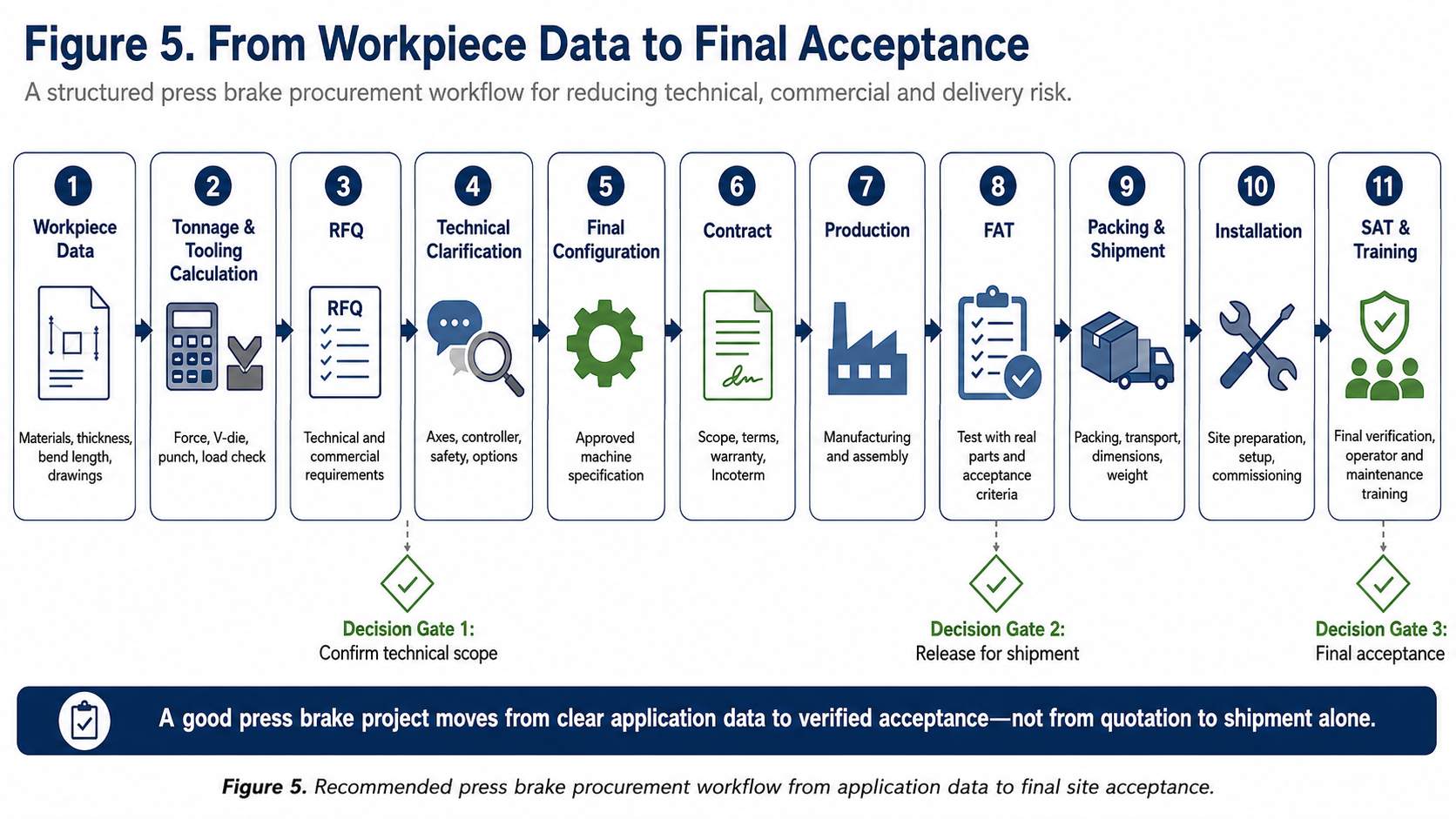
FAT should take place before final payment and shipment.
Verify:
Test:
Use contractually agreed:
Do not allow the supplier to replace the agreed material with an easier sample without written approval.
Test:
Confirm delivery of:
SAT takes place after installation.
It should include:
The contract should state what happens if the machine passes FAT but fails SAT because of transportation, installation, electrical supply or foundation conditions.
No. The article presents ten representative manufacturers with sufficient public information for structured comparison. It is not an official ranking, and the manufacturers are listed alphabetically rather than from best to worst.
They were selected using six main factors:
No public score or ranking was assigned.
Begin with your parts.
Provide representative drawings, material grades, thicknesses, bend lengths, radii, flanges, production volumes and destination-market requirements.
Then compare manufacturers using the same RFQ, technical configuration, FAT procedure and service questions.
Request:
A trading company is not automatically unsuitable, but its role and responsibility must be transparent.
At minimum include:
Not universally.
All-electric machines can offer lower hydraulic maintenance and efficient operation in suitable tonnage and length ranges.
Hydraulic and servo-hydraulic machines remain practical for many medium, large, heavy-duty and long-part applications.
The correct choice depends on the parts, production volume, machine capacity, local maintenance skills and lifecycle cost.
Simple parts may require only Y1, Y2 and X.
More complex parts may benefit from R, Z1/Z2, X1/X2 or R1/R2.
Buy only axes that solve a production requirement. More axes are not automatically more productive if programming, tooling or part handling remains the main bottleneck.
Define a FAT using real material and representative parts.
Specify:
Do not rely only on controller resolution or backgauge positioning specifications.
No.
CE marking concerns conformity with applicable EU legal requirements. It is not an independent quality ranking and does not guarantee bending accuracy, reliability or service.
Buyers should review the Declaration of Conformity and supporting machine documentation.
There is no single universal warranty.
The contract should separately state coverage for:
A long “structural warranty” should not be confused with a long warranty for the complete machine.
There is no universal best choice.
The correct Incoterm depends on the buyer’s freight experience, insurance arrangements, customs capability and control over the logistics chain.
Always identify the exact named place or port and write “Incoterms® 2020.”
Ensure that the quotations describe the same technical scope.
Compare:
The lowest machine price may not produce the lowest total project cost.
China offers a wide range of press brake manufacturers, from diversified listed machine-tool groups to export-focused private manufacturers and configurable specialist suppliers.
The ten companies in this guide represent different product and market positions. None should be selected only because it appears in a “top 10” article.
The correct purchasing process is to:
1. define representative parts;
2. calculate the required bending capacity;
3. confirm working length, stroke, daylight and throat depth;
4. list every required axis;
5. compare drive architecture;
6. define tooling and safety;
7. verify the legal manufacturer;
8. issue the same RFQ to shortlisted suppliers;
9. perform a representative FAT;
10. and evaluate lifecycle service rather than only purchase price.
A good press brake purchase is not the machine with the longest feature list.
It is the machine whose documented capacity, configuration, safety, tooling, software, service and acceptance criteria match the buyer’s actual production requirements.

E -posta adresinizi ve gereksinimlerinizi bırakın, profesyonel satış ekibimiz sizin için en uygun çözümü geliştirecektir.


telif hakkı
© 2026 Nanjing Zyco CNC Machinery Co., Ltd. Her hakkı saklıdır
.
 AĞ DESTEKLENİYOR
 Türkçe
 English
 français
 Deutsch
 italiano
 русский
 português
 español
 한국의
한국의 العربية